
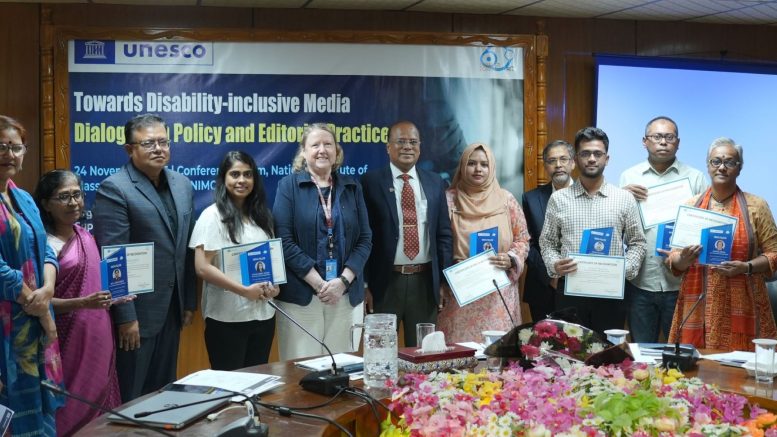
Dhaka, 24 November 2025: Speakers at a dialogue in Dhaka today stressed that the media must adopt a transformative, rights-based and diversity-focused approach while portraying persons with disabilities, noting that long-term positive change in public perception and national policymaking is possible only when journalists challenge harmful stereotypes and promote inclusion.
The event titled “Towards Disability-inclusive Media: Dialogue on Editorial Policies and Practices” was organized by Somosti in collaboration with UNESCO Dhaka Office. Senior editorial staff, journalists, disability rights advocates and development professionals took part in the event.
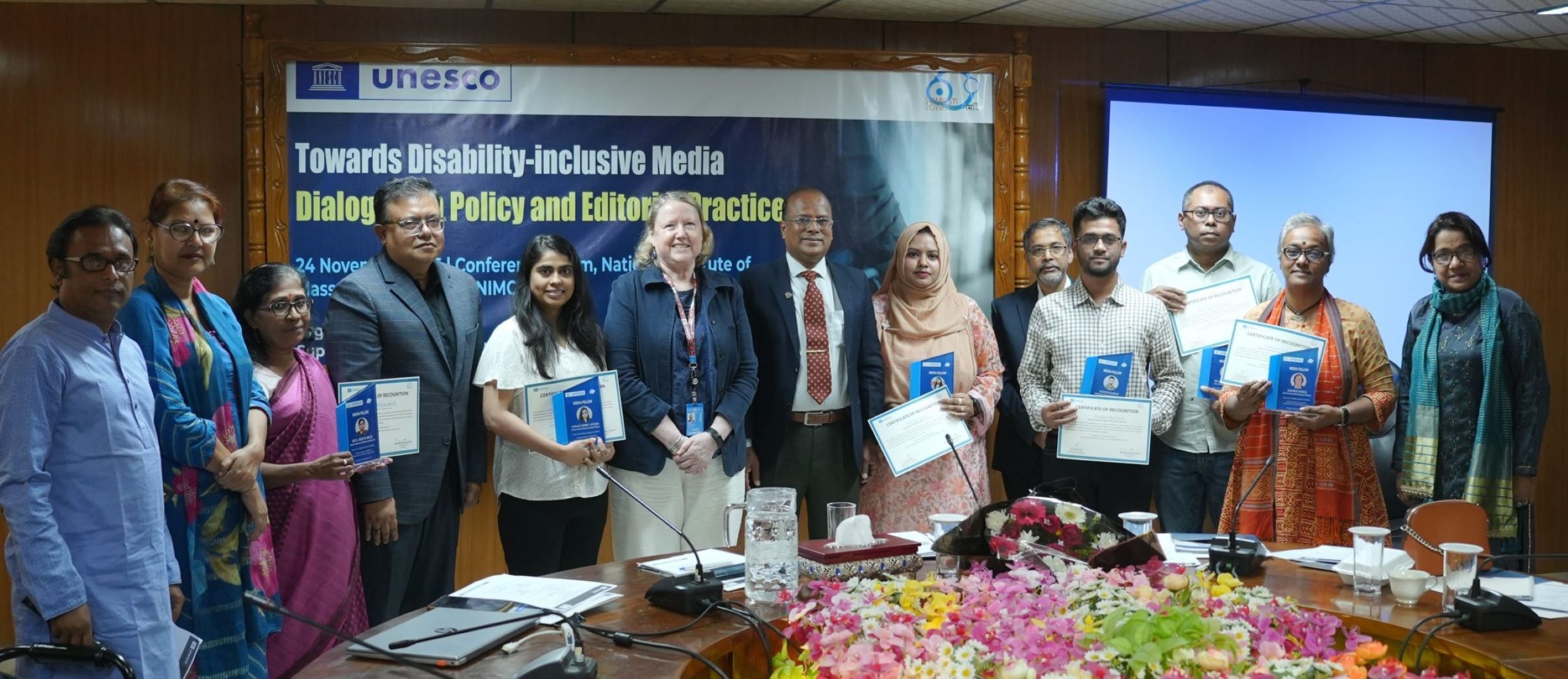 Held at the conference room of the National Institute of Mass Communication, the event was moderated by Dhaka Tribune Editor Reaz Ahmad. Dr Susan Vize, Head of Office and UNESCO Representative to Bangladesh, attended as the chief guest, while Muhammad Hiruzzaman NDC, Director General of the National Institute of Mass Communication (NIMC), joined as special guest. Somosti’s Executive Director Mir Masruruzzaman delivered the welcome speech.
During the event, media fellows under the Disability Equality in the Media initiative were awarded crests and certificates. The fellowship recipients were Asadur Rahman (Radio Padma), Kawser Soheli (Maasranga TV), Md. Manzurul Islam (Prothom Alo), Nawaz Farhin Antra (Dhaka Tribune), Nilima Jahan (The Daily Star), and Rita Bhowmik (Women Eye24.com). In addition, Shahnaz Sharmin of Ekattor TV was presented with a special crest and certificate as a mentor for the media fellowship.
Dr Susan Vize said the role of the media is vital in shaping respectful, accurate, and awareness-raising narratives about persons with disabilities. She said the media has the power to influence public attitudes and should use that power to portray disability as part of human diversity. She added that when inclusiveness is embedded in news-making and editorial processes, the media becomes a stronger ally in ensuring rights and opportunities for persons with disabilities.
Muhammad Hiruzzaman said the media must ensure inclusive practices not only in its reporting but also within its own institutional structures. He noted that providing training to journalists, strengthening sensitivity, and integrating a disability-equality perspective into policy formulation are now essential.
In the panel discussion moderated by Reaz Ahmad, participants included senior journalist Shahnaz Munni; Ayon Debnath, Campaign Adviser at Sightsavers; Vaskar Bhattacharjee, National Consultant at a2i; and Farzana Reza, National Programme Officer at the International Labour Organization (ILO).
Reaz Ahmad said an advanced society must ensure equal progress for all. Inclusion, he added, is linked not only to disability but to all marginalized groups. He emphasized the need to hold political parties accountable and observe whether disability issues are reflected in their manifestos.
Shahnaz Munni noted that societal perspectives on disability remain limited and that disability is yet to be fully recognized as part of human diversity or approached from a rights-based standpoint. She said sensitivity has begun to grow but collective effort is needed to take progress forward. Ayon Debnath said that nearly two crore persons with disabilities live in Bangladesh and the media must be more proactive in highlighting their rights and bringing their challenges into policy discussions.
Vaskar Bhattacharjee stressed that media organizations should audit the accessibility of their content and take steps to make information accessible to persons with disabilities. ILO’s Farzana Reza said initiatives for persons with disabilities should not be seen as charity but as rights. Bangladesh has ratified the UN Convention on the Rights of Persons with Disabilities and enacted relevant laws. She emphasized leadership-level sensitization and showcasing positive examples to inspire broader change.
An open discussion followed, where participants shared recommendations and reflections.