
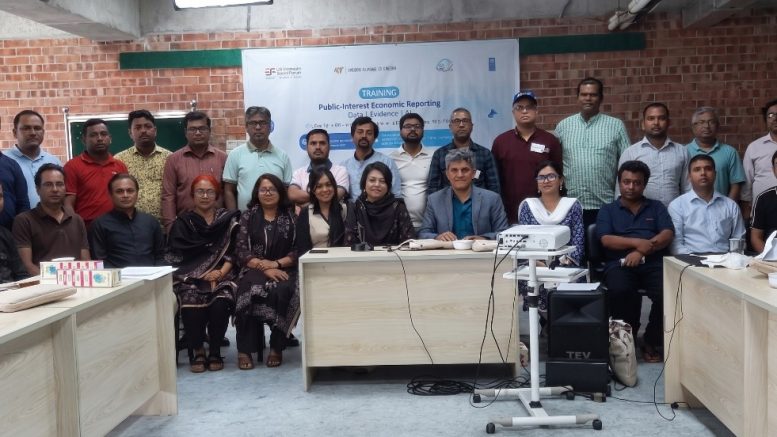
Manikganj, 8 July 2026: A three-day residential training programme aimed at strengthening analytical, evidence-based and public-interest economic journalism concluded at the GKT Training Centre in Manikganj on 8 July. Somosti Media Communication and Development Foundation organised the training with support from UNDP Bangladesh under its Transformative Economic Policy Programme (TEPP). Twenty-four economic journalists, all from the Economic Reporters Forum (ERF), including four women, participated in the programme held from 6 to 8 July.
Titled “Public Interest Economic Reporting: Data | Evidence | Responsible AI,” the training focused on helping journalists move beyond event-based reporting and explain economic policies and developments through evidence, analysis and their impact on people and businesses. The sessions covered economic policy and reform, budget and revenue, banking, trade and investment, corporate disclosure, data journalism, source development, inclusion and the responsible use of artificial intelligence in journalism.
You can strengthen that paragraph by adding how the curriculum was developed before describing the training delivery. I would suggest:
Somosti developed the training curriculum through a structured Training Needs Assessment (TNA) to ensure that the programme responded to the actual needs of economic journalists. The assessment combined a literature review, analysis of economic news reports, focus group discussions with economic journalists and editors, and consultation with economists, academics, media professionals and other experts. The findings were then used to shape the training module, practical exercises and handbook, with particular emphasis on analytical reporting, use of data and evidence, source diversity, public-interest framing and responsible use of AI.
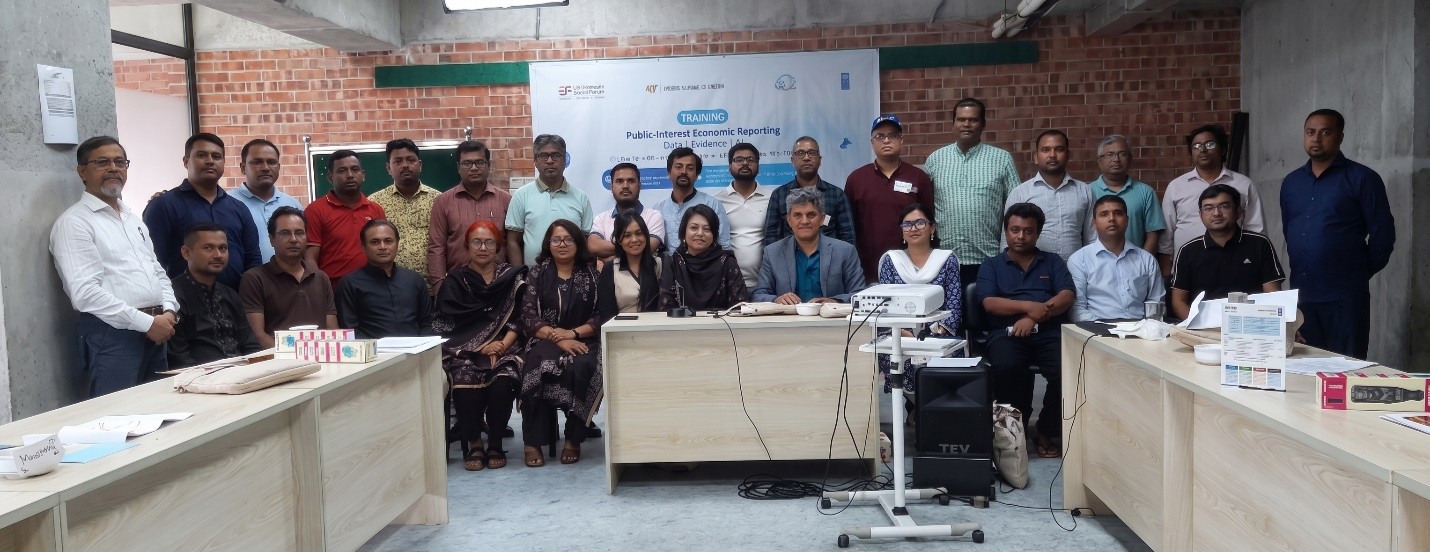
Participants pose for a group photo with the ERF President, members of the UNDP Communications Team, and Somosti staff at the end of the training.
The programme used a practical and participatory approach rather than relying mainly on lectures. Participants worked with newsroom examples, data and documents, discussed reporting challenges, experimented with digital and AI tools, and developed story ideas through group exercises and peer review. A story lab helped them turn broad economic issues into reporting plans by identifying key questions, evidence, data sources, relevant voices and follow-up angles.
Experienced journalists and specialists facilitated different sessions. Somosti Executive Director Mir Masruruzzaman served as lead trainer, while Shawkat Hossain, Reaz Ahmad, Dr. Md. Saiful Alam Chowdhury, Rezaul Haque and Snehashish Barua contributed to sessions on economic policy, banking, data journalism, AI and digital tools, financial statements, trade and investment. From UNDP, Naoshin Afroz, Communication Analyst, and Md. Iftekhar Kaisar, Monitoring, Evaluation and Learning Analyst, joined the opening and orientation sessions, while Sadia Rahman and Md. Abdul Quayyum from the UNDP Bangladesh Communications Team also contributed to the programme.
Participants highlighted the value of continued learning as economic reporting becomes more complex. “The more we learned, the more we understood how much we still need to learn. These subjects are closely connected with our reporting and will help us in future news work,” a participant representative said. ERF President Daulat Akter Mala added, “We are taking many resources from this training. Knowledge is our main capital as journalists. After this training, we feel the need to learn more, in more detail.”
Speaking at the closing, Md. Abdul Quayyum, Head of Communications at UNDP Bangladesh, described media as a partner in the development process, saying, “For UNDP, media is not only for news coverage. Media is a partner in the development journey. This training is the start of a partnership.” Following the training, participants will move into a structured mentorship process to further develop the reporting plans prepared during the story lab. With guidance from mentors and the Somosti team, they will refine their reporting angles, evidence requirements and source plans, and produce reports for publication or broadcast through their respective media outlets.